Tuesday, December 8, 2009


Tales From A Dog Catcher

Lisa Duffy-Korpics

2009, The Lyons Press (Globe Pequot)


A collection of anecdotes from the author's career in the 1980s-1990s as a young animal officer in the police department of a small city in New York state. She encounters a serial killer Great Dane mix, a Houdini Wheaten Terrier, a pair of curious raccoons, a flock of turkeys and assorted other animals wild and domestic.


The story of Manny, a streetwise Dane mix whose hobby seems to be to entice other dogs to play in traffic with lethal results, is chilling. The story of a groundhog who pulls a fast one inside the author's police car is hysterical. Most of the other tales are pleasant but predictable, and suffer from the author's perspective as a very young woman at the time.


A few stories - the Schnauzer depressed after his owner's death, the German Shepherd condemmed to death for biting a kid - are classic animal story pathos of misunderstood creatures, heartless owners and caring but powerless animal professionals. The Schnauzer story in particular annoyed me. The dead man's relations claimed the Schnauzer, an aged but relatively healthy dog, was aggressive toward anyone but the owner, and wanted the dog euthanized. The author and various coworkers, whose experience of the dog was limited to seeing it A) grief-stricken over its owner's corpse and B) depressed after the owner was taken away, quickly jump on the bandwagon that the dog, who hasn't shown them any aggression, is a great dog and the relatives are heartless jerks who want to euthanize the dog to tie up loose ends. Maybe. Or maybe the dog was always a jerk when the owner was around. I've known several dogs who were snotty when their owners were around but butter wouldn't melt in their mouths when Mommy or Daddy are absent. The relatives genuinely may not have believed the dog could change. And the dog may have been responding to the energy of a bunch of cops, all of whom are likely not shrinking violets, and wisely deciding not to act up, wheras back in a normal household he'd have reverted.


She does make one interesting observation, however, when a dying man giving up his pet cat to the shelter comments that the kind of person who adopts an animal from a shelter is going to be the kind of person who takes care of the animal.


I had never thought of it that way. I had always been fixated on trying to take care of everything myself, using the shelter as a last resort. I hadn't thought about the people who go to the shelter and deliberately choose to adopt a pet that didn't have a home. There were many of them. I saw them there all the time, yet I hadn't given them a second thought.... In some ways I had blinders on, with the single goal of controlling everything myself. Even if my intentions were good, it was emotionally exhausting. It was selfish, even narcissistic of me to think that I was the only one who could make things better.


A common issue in shelter and rescue is the volunteer who has the good intentions and love of animals, but whose actions tend to be so controlling, so convinced that only they truly care, that they can end up doing their organization more harm than good.


Overall, an enjoyable book, and one adorable cover dog.


Links

Author blog

Friday, November 13, 2009

Illustrators

Part of the reason I have such a fondness for children's books, even as an adult, is their illustrations. And animal stories always seem to get the very best pictures.

Jock's Island by Elizabeth Coatsworth, illustrations by Lilian Obligado

Lad, A Dog by Albert Payson Terhune, illustrations by Sam Savitt (special edition)

Album Of Dogs by Marguerite Henry, illustrations by Wesley Dennis

A Tree For Peter by Kate Seredy

Tuesday, November 3, 2009

The Good Luck Dog


The Good Luck Dog

Lilo Hess, author and photographer

1985, Charles Scribners' Sons

A shaggy small dog is stolen off his owner's porch and ends up sold to a laboratory. In the nick of time, he's saved from a horrible fate when an employee discovers he's been tattooed - and the lab has a policy against using tattooed animals, as it indicates they are probably pets. Sent to a shelter, he's adopted by a little boy who names him Skeeter and who is disappointed when he's unable to train the little terrier to act like a beagle. When he gets the chance to acquire a Beagle, the boy passes the pup on to a little deaf girl, who has him trained as a hearing aid dog. The initially think the little dog is a mutt, but learn that he's really a purebred Tibetan Terrier - and Heather enters him in AKC obedience trials.


A short book which is more photo-essay than novel, with brief and inelequent writing stuffed full of obvious propaganda. I don't disagree with most of the 'message' - chained dogs are unhappy, tattooing a dog provides protection against theft, etc. - but I find the flat, dull style and unapologetic pedantry unforgivable.

Dogs

Kah-Loo/Skeeter - male Tibetan Terrier

About the Author

Born in Germany, Hess grew up in Berlin and came to America in 1938. In 1939, she did PR pictures for Frank Buck, the famous animal collector whose slogan was "bring 'em back alive." Her photography and writing were featured in American magazines including Life.

Links

Lilo Hess Museum & Gallery


Other books
A Dog By Your Side

Life Begins For Puppies

A Pony To Love

Shetland Ponies

Diary Of A Rabbit

Making Friends With Guinea Pigs

A Cat's Nine Lives

Bird Companions

Christine, The Baby Chimp

The Amazing Earthworm

Animals That Hide, Imitate And Bluff

The Curious Raccoons

A Family Of Foxes

Fawn In The Woods

Foxes In The Woodshed

Listen To Your Kitten Purr

Mouse And Company

The Misunderstood Skunk

Odd Pets

Sunday, October 4, 2009

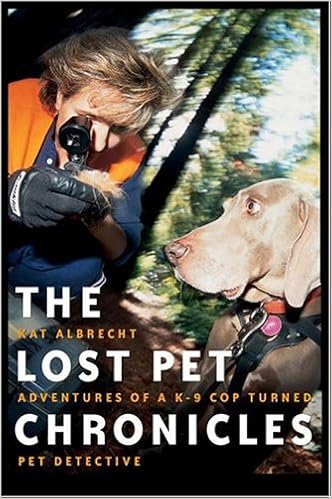
The Lost Pet Chronicles: Adventures Of A K-9 Cop Turned Pet Detective

The Lost Pet Chronicles: Adventures Of A K-9 Cop Turned Pet Detective
Kat Albrecht with Jana Murphy
2004, Bloomsbury

As a kid, the idea of chosing a dog of my own and training it to respond to my commands was pure fantasy. I had calendars and posters with dogs in my room, and I made a pastime of studying dog breed guides, carefully choosing the kind I would want for my own someday.

At 20, Albrecht got her chance and adopted a mixed-breed puppy whose background represented half of her chosen breed - Weimaraner. The other half was Australian Shepherd. With Katie, she had her first taste of owning and training her own dog, and success in the sport of flyball. Ten years later, she set out to acquire a purebred Weimaraner, and bought the puppy Rachel. At the same time, she began switching careers with the ambition of being a K-9 officer. Over the years, she trained Rachel as a cadaver dog and acquired a Bloodhound puppy named A.J. When the police career doesn't quite work out due to a combination of issues, she switched her dogs over to searching for lost pets.

It was then that I learned that the bulk of the search-and-rescue community considered tracking lost pets to be taboo. It wasn't that my peers considered the idea to be impossible - most just considered it to be beneath them.

In part, that attitude comes from pure practicality and the need to maintain the value of the dogs as human trackers - police dogs can't be distracted by animal scents while tracking a criminal or a lost child, after all. But part of it is a bit baffling. Since Albrecht had already retired her dogs from police work, she had no conflicts with their human training - now unneccessary - and after she lost one Bloodhound briefly in the woods, she had a new appreciation for the plight of owners searching for missing pets.

A very interesting book, both as a memoir and as a guide to how to find a missing pet. Cats apparently behave very, very differently than you'd think when they get disoriented from their normal routine, essentially going into a sort of silent emotional shut-down where they will not answer or go to their calling owners. Despite assumptions often made that skittish, fearful animals discovered running loose were abused or abandoned, many well-loved and spoiled house pets will behave skittishly and fearfully when lost. People who discover a stray pet will often be reluctant to turn it over to a shelter, the one place where the owner will go looking, and it's vital to put up large, unmissable signs so that they or their friends will realize that the 'abandoned' and 'abused' dog they found on the highway is really a lot pet.

Links
Author's Website
Missing Pet Partnership

MSNBC story

Thursday, September 10, 2009

She's My Girl (aka You Can't Take Twenty Dogs On A Date) (1949)

She's My Girl!

Betty Cavanna (as Elizabeth Headley)

1949, Macrae Smith Co.

Jo knelt and took Sherry's muzzle in her hand. His right eye was covered with a milky film, and as she ran her hand along the dog's back to bring him toward her for a closer inspection he suddenly yelped in pain.


17-year-old Josephine 'Jo' Redmond faces a depressing summer in suburban Pennsylvania. Her father's illness has made it neccessary for him to go away to a rest home in the Pocono mountains, resulting in a family financial crisis that's put the kibbosh on her college plans. And she misses her dog, killed recently by a car. Casting about for a money-making venture, Jo decides to start a summer boarding kennel for vacationing neighbors, since her family's oversized backyard still holds the remains of the former owner's kennels. Despite the initial discouragement of her uncle and boyfriend, Jo perseveres and begins coping with a flow of boarders, from a Houdini puppy to an abandoned Beagle. And of course, she manages to win the respect of her mocking boyfriend along the way.


This is one of Cavanna's early books, and it shows. There is some awkwardness in how she manages to provide a picture of her heroine, who looks approvingly at a friend and compares herself:


A much more striking combination than my brown eyes and almost-red hair, Jo thought.


The male disdain for female endeavour and ability is stated much more strongly and unapologetically than in later books, and the heroine is much more forgiving. This could just reflect the facts of the earlier era, but could also reflect a younger version of Cavanna. Jo is irritated by the boyfriend's attitude, but rather readily accepts the idea that men are naturally more able to do manual labor, etc.


Canine Anachronisms

Jo's puppy, Inky, died after running into the road. Both Jo and the local vet seem to feel this is just the risk run by young dogs who haven't "developed enough sense not to dash into the road without looking." The dogs eat canned horsemeat. When one dog is injured on loose wire, Jo charges the owner for the vet bills - though the dog's injuries were her own fault.


Other editions (shown above)

re-titled "You Can't Take 20 Dogs On A Date"

Betty Cavanna, il. Alex Stein (cover)

1977, The Westminster Press


Links

The University of Southern Mississippi de Grummond Collection

George School (mentioned briefly in book)

Martin's Dam Club in Wayne- Photo 1


Dogs

Suzy Beagle - female Beagle

Roger - fawn Great Dane puppy

Inky - puppy

Mac - Scottish Terrier

Bitsy - fat Cocker Spaniel

Trinket - poodle

Sherry - red Cocker Spaniel

Wednesday, August 19, 2009

Puppies For Keeps


Puppies For Keeps

Dorothy P. Lathrop, author and illustrator

1943, The Macmillan Company

A rather thin story of two children who watch a litter of Pekingese puppies grow up. The writing is uninvolving, but the illustrations are lovely.


About the Author

1891-1980

Dorothy Pullis Lathrop

The winner of the first Caldecott Medal, for her book Animals Of The Bible in 1938, Lathrop was most famous for her illustrations in Rachel Field's 1930 Newberry Medal book, Hitty, Her First Hundred Years. Much more information can be found at the following websites.


Links

BPIB

Two

A Journey Round My Skull Blog


Books written and illustrated by author (partial list)

Dogs

Dog In The Tapestry Garden

Puffy And Seven Leaf Clover


The Fairy Circus

The Colt from Moon Mountain

Angel in the Woods

Bouncing Betty

Let Them Live

Littlest Mouse

Skittle-Skattle Monkey

Follow The Brook

Who Goes There

Hide And Go Seek


Books illustrated by author (partial list)

Tales From the Enchanted Isles by Ethel May Gate

The Three Mulla-Mulgars by Walter de la Mare

Down-A-Down Derry by Walter de la Mare

Crossings by Walter de la Mare

Dutch Cheese by Walter de la Mare

Mr. Bumps And His Monkey by Walter de la Mare

Bells And Grass by Walter de la Mare


Related

The Caldecott Medal

The Caldecott Medal was named in honor of nineteenth-century English illustrator Randolph Caldecott. It is awarded annually by the Association for Library Service to Children, a division of the American Library Association, to the artist of the most distinguished American picture book for children.

Source: American Library Association


Newberry Medal

The Newbery Medal was named for eighteenth-century British bookseller John Newbery. It is awarded annually by the Association for Library Service to Children, a division of the American Library Association, to the author of the most distinguished contribution to American literature for children.

Source: American Library Association

Wednesday, August 12, 2009

Dixie Of Dover: A Boy And Dog Story (1958)

Dixie Of Dover: A Boy And Dog Story

Jean Poindexter Colby, il. Mary Stevens

1958, Little, Brown and Company


Fists began to fly when suddenly a small furry object hurtled into the fray. It was Dixie, growling and snarling, bristling and biting.


Ten-year-old Gersholm Converse Montgomery III (aka Gerry) gets the little Welsh Terrier pup Dixie as a gift from Lt. John Reed, who is forever grateful to Gerry's dad, Captain Converse Montgomery, for saving his life in WWII. The captain is dying of a blood infection picked up in the Pacific, and when he dies, the scrappy little dog helps everyone adjust to a new life in the city. He accompanies Gerry on a paper route to help with the family finances, and pitches in when Gerry tangles with tough new neighbor Bill O'Brien.


Almost English, with the genteel family moving from a rural estate in Dover and private schools to an old-fashioned house owned by their grandmother in a dodgy neighborhood in Brookline and public schools. And the following scene of an obnoxious child is almost too Brit to bear:


...a boy who pranced up to Gerry and said, "I'm going to have your room and I'm going to mark up that fancy wallpaper, and bust up your birdfeeder, and grind a hole in that workbench."


But there's an air of realism in the book - the family is never said to be poor, simply not as well off as previously. In short, they had to let the maid go and sell the 15-acre gentleman's farm, but they still have a big city house (albeit in a less nice area) and a maid.


Who is Irish. And big and bossy. It was inevitable she'd be either Irish or Negro (to use the term which would have been used here, likely). The mild-mannered WASPy family fits in fairly well with their new neighbors, whose multiculti 1950's style features the friendly Italian family the Delasapios, and the surly, touchy Irish kid Bill. And there's some other fun fifties stuff.


"What's a pizza?" asked Gerry.


Although Bill probably saves Gerry's life by advising him to NOT wear capri pants to public school (ok, I know they weren't capris, but - they looked it.) but remains wary of Dixie and unfriendly except to Mrs. Montgomery, who keeps encountering him in her new job at the local library. There's an odd sort of twist at the end, but until that point it's quite satisfying.


Dogs

Dixie - male Welsh Terrier

Duzzy - male spaniel mix puppy


Other books

Dogs

Jenny


Other

Peter Paints The USA

Jim The Cat

The Elegant Eleanor


Nonfiction

Plimoth Plantation Then And Now

Tearing Down To Build Up

Writing, Illustrating And Editing Children's Books

Mystic Seaport: The Age Of Sail

The New Wellesley

The Children's Book Field

Lexington And Concord, 1775

Jesus And The World


About the Author

Jean Poindexter founded Junior Reviewers, a monthly magazine which reviewed new children's books, and was an editor at Ariel Books.


Links

The U. of Southern Mississippi, du Grummond collection