Sunday, April 25, 2010

Old Arthur (1972)

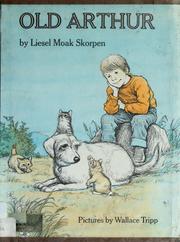
Old Arthur
Liesel Moak Skorpen, il. Wallace Tripp
1972, Harper & Row

It was Old Arthur's job to wait for William while William was at school. That old dog was very good at waiting. He had waited all his life.

An old farm dog, unwanted by his owner because he's too old to continue herding the cows and guarding the henhouse, finds a new home with a little boy.

Wagging that woolly tail was the most important job that that old dog did.

A sweet, old-fashioned story of an unwanted dog who faces harsh rejection only to find love with a little boy who, unusually, appreciates the very qualities that others disliked. The illustrations add punch to the story, and ably demonstrate how the love between boy and dog makes the old dog beautiful.


Other books by Liesel Moak Skorpen
All The Lassies
His Mother's Dog
We Were Tired of Living in a House
Outside My Window
Charles

Tuesday, April 20, 2010

The Visitor (1971)

The Visitor

Gene Smith, il. Ted Lewin

1971, Cowles Book Company


"Good-bye, little fellow," the man said. But he said it so softly that his wife and children could hardly hear him - let alone Sassafras, who was already inside the building.


Sassafras, a six-month-old Irish Setter, is left at a kennel while his family goes on a weeklong trip. But when a car accident kills his master during the trip, the widow decides the pup's return home will be too sharp a reminder to their children. She pays the kennel to keep him indefinitely, leaving the poor dog in eternal limbo. The gentle setter never fogets his beloved Home, but takes pity on the homesick dogs around him, comforting and protecting them.


An incredibly sad story, told from the point-of-view of Sassafras, who understands human speech enough to realize that his owner is dead, speaks with his fellow inmates and retains a memory so strong of his home and people that when he sees the kennel owner clean away old bones


Sassafras stopped chewing on his old bone because he did not want it taken away. It spoke to him of home. Instead he carefully put it to one side where he could always look at it.


A horrendously manipulative tear-jerker. And, horribly, based on a true story of an Irish Setter left at a boarding kennel for 13 years. The woman as a shallow monster who leaves the dog in limbo may have been completely true to life, but it stirs up ugly echoes of those old-school dog tales where men are the only gender truly fit for the loyalty and faith of a canine companion, because women are too concerned with clean floors.


Other books

The Hayburners

The Winner - juvenile horse novel (1970)


Nonfiction

When The Cheering Stopped (bio of Woodrow Wilson)

Still Quiet On The Western Front: Fifty Years Later

The Shattered Dream: Herbert Hoover In The Great Depression

Maximilian And Carlotta (bio)

Lee and Grant (bio)
High Crimes & Misdemeanors: The Impeachment of Andrew Johnson

American Gothic: The Story of America's Legendary Theatrical Family

The Dark Summer

The Police Gazette (ed., with Jayne Barry Smith)

The Champion (horse)

Thursday, March 11, 2010

Yankee Boy (1971)


Yankee Boy
Edmund O. Scholefield, il. Lewis W. Gordon
1971, The World Publishing Company

Ted wasn't exactly afraid of dogs, but neither was he exactly comfortable with them, either.

Ted Roche is a 14-year-old New Yorker when his widower dad remarries. Ted gets along fine with Loulou, a friendly artist who freelances for his dad's Madison Avenue advertising agency. But when her mother dies and Ted is taken to rural Alabama for her funeral, he enters a different world, one where he's unexpectedly stranded when his parents decide to leave him with his grandfather while they honeymoon.


Resentful and leery of the 'hillbillies' surrounding him, Ted quickly gets into one sticky situation after another with everyone from his grandfather to his new school's principal. His sole friend through this is the one he really didn't like at first, the pregnant hunting dog Sarah. And even as he begins to adjust to things, his reluctant fondness for Sarah - and then her puppies - remains. She has, after all, provided the catalyst for his changing view of his new environment.

The dog sat down beside him. Ted looked around him for a moment, and then, quite idly and without thinking about it, picked up a stick a foot and a half long, and then spun it through the air. Instantly, moving faster than he had ever seen her move before, Sarah took off in pursuit of the stick.

At some point in the 1960's, an older generation of children's writers attempted to adapt their style to a society that had changed enormously. In the earlier era, children were children up till about 18. They learned wise lessons from their elders; boys were physically punished if they misbehaved and not only accepted it but recognized it was just and right; girls realized that they could be bright and creative with their children when they married after college, and recognized that they had a duty to emotionally bolster all males that crossed their paths. In the later era, children became teens with Important Ideas and Thoughts to share; their elders learned from them, eventually. Both eras had some drawbacks, but at least books falling solidly on one side or the other had an internal consistency. Books like Yankee Boy straddle the line, uncomfortably.

There is a classic old-style plot of a boy learning to adapt to an unfamiliar place, learn humility, discover older values, and become a man. And then there is the window dressing of the later era - the mod clothes, the long hair, the kid's cool interior monologue. There are a couple of pointed shots at the culture wars raging around the late 1960s and early 1970s, namely the references to Ted's clothes and hair, the bits about black/white relations in the grandfather's household, and the total lack of reference to a certain military action. It's clear that Scholefield was old-school; his hip, urban teen is dragged out to the rural South to learn how to be a man, and leave behind the effete kid who doesn't like dogs and hates having his clothes mussed.

I grew up reading the old-school books, and I like them. But that style always had its ugly side - a smug, complacent attitude that what worked in 1842 will work today, that women and blacks and everyone else who isn't a white man with some money was better off back in the traditional world - and while you could just barely accept it as self-serving blindness in a book written in 1930 or 1950, there was no justification for one written in 1971. It was pure backlash, and pathetic.

Fun anachronisms: the reference to 'way out' clothes, which the author cagily never really describes, the father's crankiness about the son's long hair, the way the city boy's never heard of deer as a danger to cars, and, best of all, the reference to Beau Brummell.


Dogs
Sarah - 6-year-old black Lab, champion field hunter
Horace - Golden Retriever
Blackie - Lab
Yankee Boy - Lab

Links
Fantastic Fiction
Wikipedia on author
Beau Brummell at Wikipedia
Scout (the weird car the grandfather drives)

About the Author
1929-
Scholefield is a pseudonym for the author William E. Butterworth, who also used the pseudonyms Alex Baldwin, Webb Beech, Walter E. Blake, Jack Dugan, John Kevin Dugan, James W.E.B. McM Douglas, Allison Mitchell, Griffin, Eden Hughes, Blakely St. James, and Patrick J. Williams. As this implies, he wrote a lot of books, all under various names. His books for teens and children were under the name Scholefield.

Books as Scholefield
L'il Wildcat
Bryan's Dog
Maverick On The Mound
Tiger Rookie
Wednesday, February 17, 2010

Scotty wins Westminster; crowd horrified at reminder that mutts exist

from The Morgan Dennis Dog Book by Morgan Dennis


A Scottish Terrier named Ch. Roundtown Mercedes Of Maryscot (aka Sadie) wins Best in Show at Westminster. PETA protestors sneak in and hold up signs saying "Mutts Rule" and Breeders Kill Shelter Dogs' Chances." I'm not a PETA fan, but they have a point. Not so much about the breeders, perhaps, but certainly about a) that mutts rule and b) the AKC does kill shelter dogs' chances - by refusing to crack down on puppy mills and high volume breeders, the AKC is helping create thousands of puppies who are prime candidates to end up in shelters.

Sadie's had a heck of a few months. She also won Best in Show at four clustered shows at the Kennel Club of Philadelphia in November, and at the Eukanuba National Championship Dog Show in California in December. Her breeder is Anstamm Scottish Terriers.


And some books featuring Scotties. And some other media too.

Picture books

Bios
First Dog Fala by Margare Suckley and Alice Dagliesh

Short stories
James Thurber's Jeannie stories, including Look Homeward Jeannie and In Defense Of Dogs, Even, After a Fashion, Jeannie. Which can be read online at Google Books.

Other Scotty stuff
Fala info at the National Park Service
Buy a Fala tile at the FDR Presidential Library and Museum
FDR Memorial with Fala
And, of course, the more recent Presidiential Scotties, Barney and Miss Beazley

Sunday, February 14, 2010

The Trouble With Tuck (1981)


The Trouble With Tuck
Theodore Taylor
1981, Doubleday

And if there was anything better to hold than a pup, I don't know what it was. I put him up to my shoulder, against my neck, and his warm tongue swabbed the lobe of my ear. His new fur was like velvet. A love affair began that hour.

It's early 1950's Los Angeles, and 10-year-old Helen Ogden is a shy girl lacking self-confidence. One day, her parents present her with a fat gold Labrador Retriever puppy. Officially christened Friar Tuck Golden Boy, he's just Tuck to Helen. The pair become inseperable, and within a short time Tuck has saved her life twice, once from a pervert in the park and once from drowning in a pool.

But 1956 is different. Tuck, now over three, runs through a screen door and the family begins to wonder if his eyesight is okay. When the vet says Tuck is going blind, there are few alternatives. Helen, miserable at how her beloved dog is suffering from having his freedom curtailed, comes up with an idea nobody thinks will work - get her blind dog a guide dog of his own.

At first, the guide dog organization gently tells Helen that their dogs are far too valuable to be used with another dog. But then a unique situation occurs, and Helen has her chance to use the German Shepherd guide dog Lady Daisy. The only question left is how to train the obdurate, jealous Tuck to put up with a canine housemate and follow a guide.

The free-running Tuck's easy off-leash social life is an anachronism that somewhat confuses the big problem of the book. Today, a family dog in suburbia wouldn't be allowed to run loose, and the only problem involved with having a blind dog would be making sure nobody touched him unexpectedly. The scene where Tuck saves Helen from a pervert in a fog-bound park is scary as hell because of the realism of the scene. Where today a narrator would vague out into "And then everything seemed to slow down and I was thinking of bluebirds." Helen faithfully recounts every last detail of the attack.

Clearly written, with a consistent character voice and appealing heroine and dogs.

Dogs
Friar Tuck Golden Boy - golden Lab with Dudley nose
Lady Daisy - German Shepherd


About the author
1921-2006
The North Carolina native wrote over 50 books. A high school dropout (math issue, my sympathies) he went on to become a press agent and screenwriter in Hollywood. His most famous book was the 1969 YA novel The Cay.

Other Books by the author
There are far too many to list; most relevant is the 1992 sequel, Tuck Triumphant.

Links
Author website
LA Times obituary

Editions


Avon Camelot, 1981 Yearling

Also, an unknown edition cover

Monday, February 8, 2010

Adopt a Shelter Dog!

from Marguerite Henry's Album of Dogs, illustrations by Wesley Dennis

Adopt a shelter dog in 2010 and get free dog food from Pedigree! Details here.

Please choose a good shelter and use your head as well as your heart in choosing a pet. There are many homeless dogs out there, and many of them are not right for various homes. Owning a dog should be a joy, not a grim duty. Your priority is not to prevent a dog from being euthanized, it's to acquire a lifelong friend and companion. Do research on local shelters, because there are some bad ones out there that should not be encouraged to stay in operation. Find one that honestly attempts to weed out aggressive and unhealthy dogs, does a thorough but reasonable background check of hopeful adopters, does some vet work (at the very least, a rabies shot), and has a clean facility.

Pedigree, of course, is the dog food manufacturer who did those heartbreaking commercials a few years back featuring shelter dogs and a voice-over by David Duchovny.


Saturday, February 6, 2010


No reviews at the moment, but here's an old magazine cover that fits the snow-covered world outside so many windows tonight.


Note: the November 2009 post about The Good Luck Dog by Lilo Hess has been updated with photos.